

Remember the last time you said 'just one more round' and then looked up to find it was past midnight? That wasn't luck. It was design. Somebody sat down and decided how fast the enemies move, when the next reward shows up, and how annoying a loss should feel. A designer made those calls, along with artists, animators, programmers and sound people, all arguing over the details.
We will walk through how a game goes from a rough idea to something that's hard to put down. Then comes the practical bit: game design courses, what makes a game animation course different from a general one, and what the game designer salary in India looks like when you check it against actual numbers.
Table of Contents
- The Idea: Where Every Game Begins
- Rules and Balance: The Thinking Behind the Fun
- Levels and Story: Teaching the Player Without Words
- Art, Animation and Sound: Making the World Feel Alive
- India's Gaming Industry: A Growing Playground
- Learning the Craft: Game Design Courses
- Game Designer Salary in India: What to Expect
- Course Details to Check Before You Join
The Idea: Where Every Game Begins
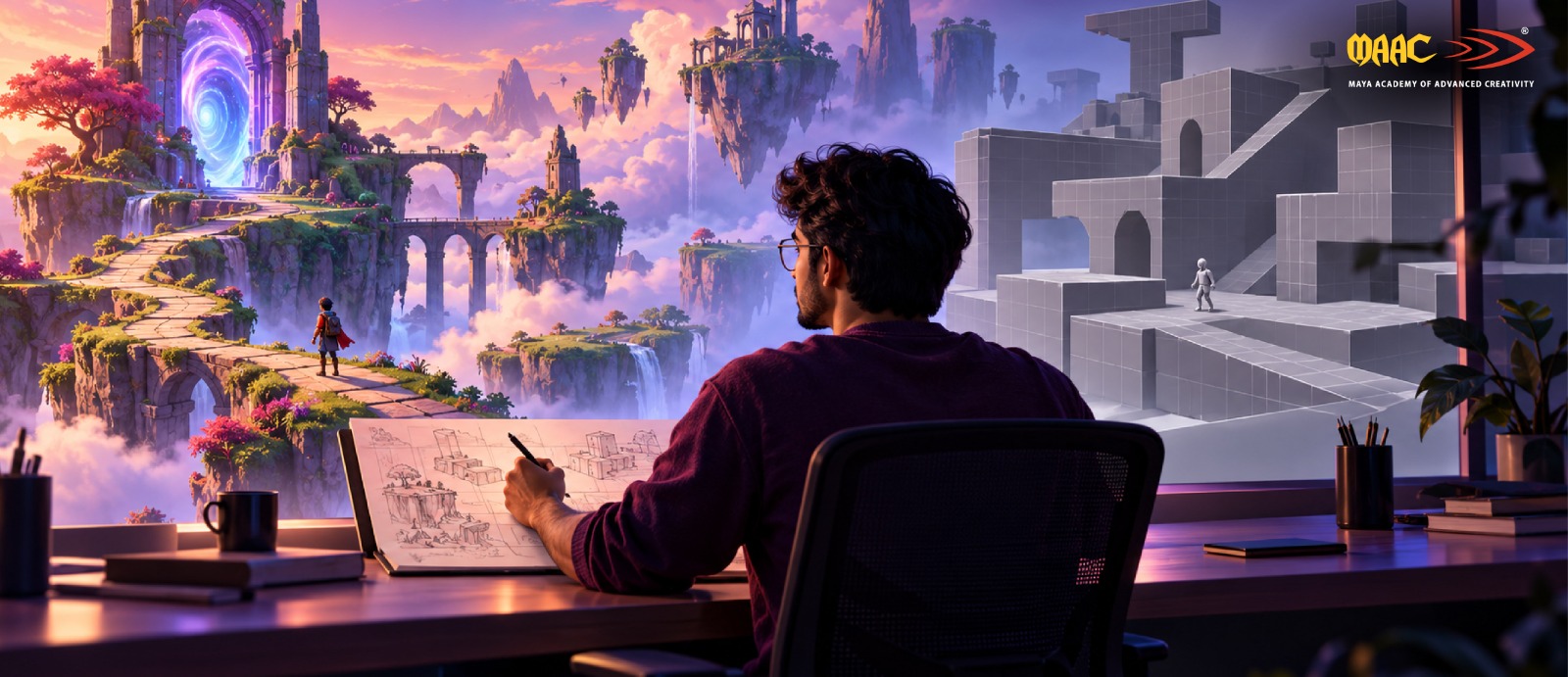
Most games start with a sentence that you could say out loud in ten seconds. A lost robot wants to return and the rooms change whenever it blinks. That is all. No long story, no world. Just a. A question that the player wants answered.
Then comes the part people skip the core loop. It is what you do again and again: explore, fight, gather loot, upgrade. The loop must be fun when the art is turned off so designers test it with boxes, cards and even paper. A bad idea dies cheaply on day three. By month ten it can erase a lot of people’s effort.
Rules and Balance: The Thinking Behind the Fun
Behind every engaging game lies a series of carefully thought-out decisions. How fast should the hero run? How powerful should the enemy be? Should the first reward appear after five minutes or fifty?
Even the smallest adjustment can change the entire gaming experience. Make it too difficult, and players may get frustrated and quit. Make it too easy, and they might lose interest altogether.
The real challenge is finding the right balance between difficulty and the player's growing skills. Psychologist Mihaly Csikszentmihalyi described this state of complete engagement as flow, a concept widely used in game design.
But achieving that balance takes more than theory. It requires constant testing, observing how players respond, identifying what works and what doesn't, and making improvements until the experience feels just right.
Story: Teaching the Player Without Words
Think of a level as a teacher that never speaks. In the opening level of Super Mario Bros. many designers note that you meet one idea at a time in a safe place before anything punishes you. No tutorial text is needed. You just try, fail a little and learn.
Story hides in the places. A torn poster. A dinner nobody finished. A door barred from the inside. Level designers and narrative designers leave clues like these around. You put the plot together yourself. It feels clever when you spot one. If a character explains everything loud it feels like a lecture.
Art, Animation and Sound: Making the World Feel Alive
Now the game needs a face. Concept artists set the mood character artists draw the heroes and villains and environment artists build the world around them. Then animators step in. A character’s walk tells you if the character is tired, cocky or scared and you read it instantly. A heavy character stomps. A nervous one keeps glancing. Games add a twist that films do not have: the player’s hand is, on the controller. When someone presses jump the character must leap that instant. It still has to look natural..
India's Gaming Industry: A Growing Playground
So is there space for a newcomer? There is, but let's look at the numbers carefully. Lumikai's report from March 2026 says India's video games market, leaving out real money gaming, was around $1.5 billion in 2025, up 17 per cent. It projects about $3.2 billion by 2030. The number of gamers fell by roughly 9 per cent to around 555 million, yet spending still went up.
Earlier Lumikai’s 2024 report ranked India worldwide for mobile game downloads at about 15.2 billion. In August 2025 India also banned real money gaming by law which shows how fast rules can change this part of the business. The games that are still allowed need designers, artists, animators and programmers. That’s the opening.
Learning the Craft: Game Design Courses
How do people actually learn this? The better game design courses start with thinking before software. You study what makes a game fun write a design document build a prototype and then learn to listen to feedback without getting defensive. Tools come later. Expect Unity or Unreal Engine, plus Blender or Maya for the art side.
Not all programmes are the same. Some courses for game designing focus on mechanics, levels and storytelling. Others go technical with scripting and engines. If movement and characters are what excite you find a programme that spends time on rigging and polish.. If you’re still unsure gaming and animation courses mix design, art and animation so you can try each one.
Game Designer Salary in India: What to Expect
Everyone asks about money so here it is. The game designer salary in India isn’t a tidy number and the salary guides I checked don’t agree with each other down to the rupee. Think of this as an idea, not a guarantee.
Guides from 2025 and 2026 suggest entry level designers often start around ₹3 to 6 lakh a year. After a years mid level designers are commonly quoted at roughly ₹6 to 14 lakh. Senior designers and leads begin near ₹12 lakh. Can go well past ₹20 lakh at bigger studios. Indie teams generally pay less and less predictably though some offer a share of revenue.
What decides where you land? Your specialisation, for a start. A designer who can script in Unity or Unreal is worth more to a team. Your experience and a portfolio of finished games people can actually play, matter a lot. Then location (Bengaluru, Hyderabad and Mumbai often show up as the paying cities) and the studio itself. A big funded company pays differently from a small startup. So look at job listings for the exact roles you want before you plan around any number.
Course Details to Check Before You Join
Brochures start to look the same so don’t stop at the page. Before paying anything read the details of courses for game designing line by line. What does the syllabus cover. Design thinking, prototyping and testing or just software? How long is it? Which engines? How playable projects will you finish? Do you leave with a portfolio?
Then ask about the people. Who. Have they worked on games that shipped? Is feedback regular. Saved for the end? Is placement help real or just a line on a brochure? If you’re torn between a game animation course and the gaming and animation courses ask which job you’d happily do every day for three years. MAAC is one institute that offers training across animation, VFX and gaming with projects so students finish with a portfolio and not just notes.
Conclusion
Every game you remember came from a crowd of people. Designers, artists, animators, programmers, sound people, testers. All working on something none of them could finish alone. When it works you stop noticing the craft and just enjoy the game.
If any of this caught your attention begin with game design courses. Notice which part of the process makes you forget the time. Courses for game designing suit you if systems and ideas excite you. A game animation course suits you if movement does. Gaming and animation courses are, for people who want a bit of both. Then make something small. Let people play it. Don’t wait until you feel ready.
FAQs
- What does a game designer actually do?
Ans - They work out how a game plays and why it's fun: the rules, the goals, the difficulty, the pacing of rewards, the way levels teach. On a small team one person may cover several of those jobs, and designers are constantly talking to artists, animators and programmers.
- What is the difference between game design and game development?
Ans - Design plans the experience, meaning what the player does and how it feels. Development covers the full job of building it, including programming, art, animation and testing. They overlap a lot, and plenty of people move from one to the other.
- Are game design courses a good choice for beginners?
Ans - Usually yes, especially if you haven't picked a direction. A decent programme lets you try design, art, basic scripting and animation so you can see what clicks. You don't need to be good at any of it on day one.
- What is the eligibility for courses for game designing?
Ans - Courses for game designing depends on the programme. Many beginner level ones ask only for completed school education, while advanced ones may expect some drawing, design or coding background. Check the course page or ask the institute's counsellor.
- What will I learn in a game animation course?
Ans - Expect movement basics like timing and weight, character poses, rigging, and animation that reacts to the player's input. You'll also learn to bring your work into a game engine.
- What do gaming and animation courses cover?
Ans - A blend of game design basics, 2D or 3D art, animation and engine work. They're handy if you want to keep your options open before choosing between design, art and animation.
- What is the average game designer salary in India?
Ans - It depends on your specialisation, experience, location and the studio. Recent guides suggest roughly ₹3 to 6 lakh a year at entry level, ₹6 to 14 lakh at mid level, and from about ₹12 lakh to well past ₹20 lakh for senior roles. Treat these as broad ranges and check current listings.
- How long does a game design programme take?
Ans - Short certificate programmes can run a few months. Diploma style ones that cover the whole workflow may take a year or more, with design plus animation programmes usually at the longer end.
- What career options are there after a game design programme?
Ans - Several paths open up: game designer, level designer, narrative designer, game artist, game animator, technical artist or QA tester. Game studios, mobile game companies, ad agencies and learning platforms all hire for them.
- How much does a game design programme cost?
Ans - Fees vary with the institute, the length of the programme and the city. Ask for the complete breakdown, including software, materials and exam charges, so you can compare like with like.
- How do I choose the right institute?
Ans - There's no single answer. Use one checklist for every place: syllabus, trainers with studio experience, project work, portfolio support and placement help. Put MAAC next to the others and compare honestly.