
If you are thinking about a Career in 3D and real-time rendering, here is the thing. Speed has become as important as skill. Studios no longer want artists who wait hours to export files across platforms for rendering, visualization, and iteration. They want creators who can preview scenes instantly, make changes on the fly, and deliver faster than ever. This is where real-time design and Unreal Engine step in.
By 2026, real-time pipelines will be the norm across animation, gaming, architecture, product demos, and virtual production. Students who learn 3d animation today are entering an industry where waiting overnight for a render feels outdated. At MAAC, this shift is already reflected in how 3d animation courses and real-time workflows are taught, especially through a structured 3D and Realtime Design course and an industry-focused advanced 3D animation program.
1. Building assets right from day one
At MAAC, students learn early that production speed depends on efficiency of workflow, not merely render time.
Poor topology, High-Poly, Unoptimized Assets, and Excessively Large Texture Maps don’t just slow export times they slow down entire pipelines. That’s why MAAC emphasizes professional asset creation from the very first stages of training.
This approach is taught early in a solid design visualisation course, where students learn to think like professionals, not hobbyists.
When assets are built correctly, export times can be significantly improved.
2. Smarter lighting for faster results
Lighting is where many artists lose time — and MAAC trains students not to.
Students are guided to understand how lighting choices impact performance in real-time environments. Students learn how Unreal Engine handles real-time lighting, shadows, and reflections, and how smart lighting choices can help improve export efficiency.
By understanding when to use real-time solutions and how to balance realism with optimization, MAAC students develop faster, more reliable workflows aligned with industry practices. This performance-first mindset is what separates trained professionals from trial-and-error learners.
3. Using Unreal Engine workflows correctly
At MAAC, Unreal Engine is never taught in isolation.
Students are trained to understand real-time production workflows from asset creation and scene assembly to interactive previews and final outputs. Students are introduced to Unreal Engine workflows used in real-time pipelines, focusing on practical application within the scope of the MAAC curriculum. They understand how assets move from modeling to animation to final output without breaking the pipeline. That understanding alone can reduce export times by hours every week.
4. Optimizing scenes for real-time design
Real-time design isn’t about pushing limits blindly. It’s about making smart creative choices.
MAAC places strong emphasis on scene optimization teaching students how engines interpret scenes, understand how real-time engines handle performance and optimization. This expertise is essential for architectural walkthroughs, product demos, virtual sets, and immersive experiences where seamless real-time performance is non-negotiable.
A good design visualization course trains students to see scenes the way engines see them. Once you understand that perspective, export times drop naturally because the engine is no longer overloaded.
5. Why training matters more than tools
Here is what many people miss. Unreal Engine alone will not make you faster. Students are trained using workflows inspired by current studio practices. They learn shortcuts, workflows, and decision making that save time every single day. This is why many students who learn 3d animation & Real time pipeline through structured programs benefit from structured guidance and organized workflows.
At MAAC, real-time rendering is not treated as a trend. It is integrated into 3d animation courses with clear career outcomes in mind.
Where MAAC positions your career in 2026 and beyond
Real-time rendering is becoming the backbone of modern creative production. Artists who understand real-time pipelines don’t just work faster, they collaborate better, iterate smarter and earn greater trust from studios.
MAAC aims to align learning with current industry directions in real-time design.
With MAAC, Students are trained with an eye on emerging industry standards.
They are training with emerging industry standards in mind.
Because in the future of 3D, animation and real-time design, careers are built by creators who can bring ideas to life, instantly.



5 January 2026
Real -Time Rendering in 2026: 5 Secrets to Slashing Export Times using Unreal Engine
Recent Posts
How to Build a Career in Anime: Exploring 2D and 3D Animation Opportunities in India
Beyond the Classroom: How Studio Visits Give Animation and VFX Students Real World Industry Exposure
How VFX Transformed Indian Cinema: The Rise of Visual Storytelling on the Big Screen

Essential Tools for Digital Creators: How a Digital Content Creation Course Prepares You for Real World Production
From MAAC Classroom to Mirzapur: How Animation and VFX Training Can Lead to Successful Careers in Film and OTT
A Parent’s Guide to VFX Careers: How MAAC India Helps Students Prepare for Careers in Top Media Studios
From Sketchpad to the Silver Screen: What You Learn in a 3D Animation Film Making Course
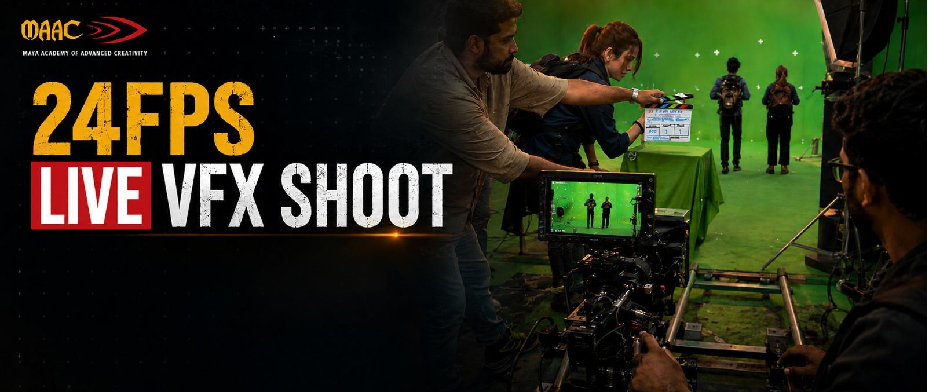
Behind the Scenes of the 24FPS VFX Shoot: Where Creativity Meets Industry Practice
Your Future Starts Here!
Discover a wide range of programs designed to empower your future. Whether you're starting your academic journey or advancing your career, our courses are tailored to help you succeed in today’s competitive world.
Start Your MAAC Journey
Reach out to us today and take the first step toward your creative journey with MAAC.

Ask Me